Live in Florida
Florida EMS protocols,
Florida EMS protocols,
in your pocket.
Offline, county-specific protocols for Florida EMS providers — searchable, with a full medication reference, hospital finder, and study tools built in.
Protocols current as of October 1, 2026
See it in the field
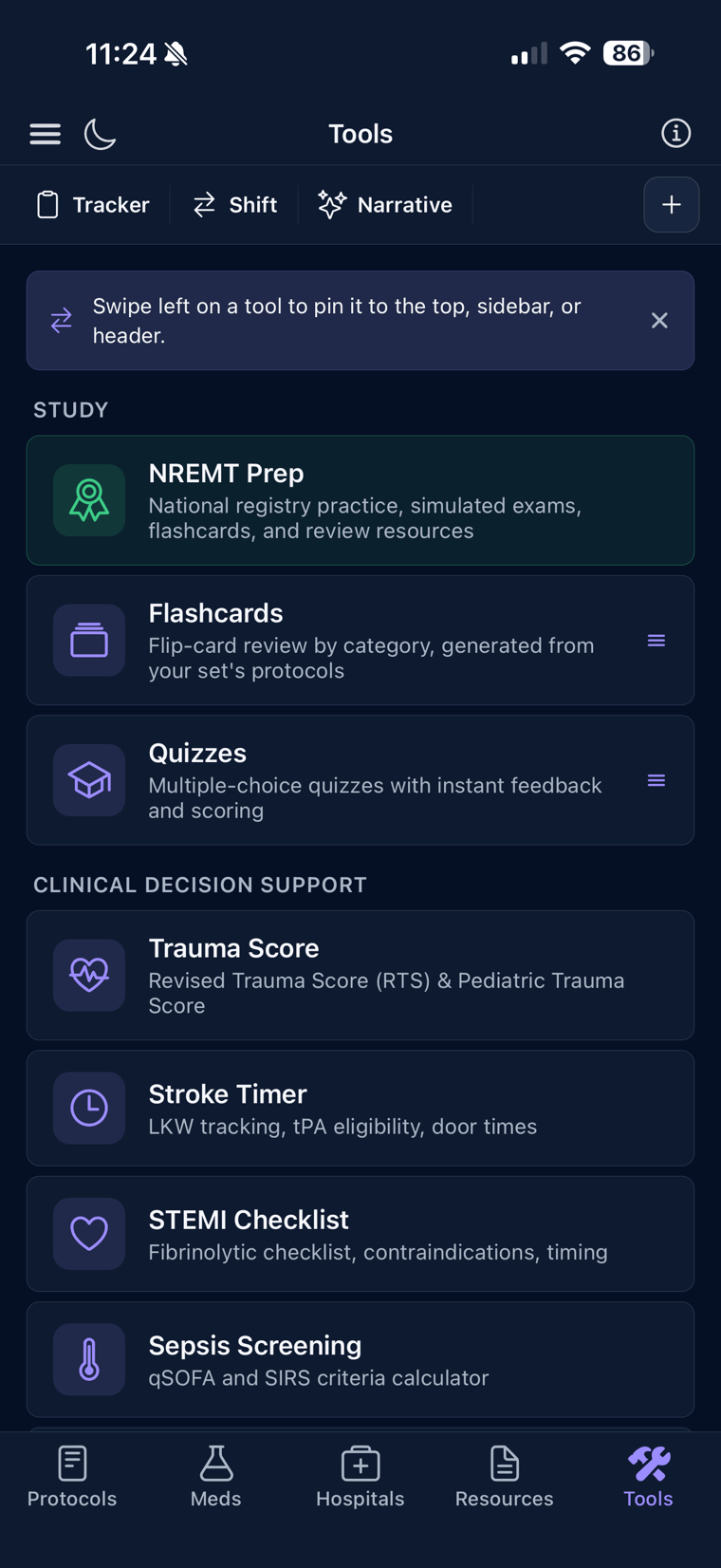
Pocket Protocols showing Florida's protocols, medications, and hospitals — searchable and fully offline.
What's covered in Florida
The protocol sets serving Florida right now.
Kissimmee Fire Department & St. Cloud Fire Rescue
July 2026 ↗
PDF document
1,282
Flashcards
690
Quiz questions
38
Medications
3
Resources
Miami-Dade Fire Rescue
Medical Operations Manual (2026-09-29) ↗
PDF document
1,302
Flashcards
683
Quiz questions
42
Medications
3
Resources
Southwest Florida Regional Common Treatment Guidelines (Lee County EMS)
2026.1.1 (Revised 8/2026) ↗
PDF document
1,218
Flashcards
642
Quiz questions
45
Medications
6
Resources
Study tools for Kissimmee Fire Department & St. Cloud Fire Rescue
A few real flashcards and quiz questions from Florida's own protocols — the full set, plus a spaced-review deck, is in the app.
Flashcards
Procedures – Carotid Ultrasound: vessels to identify
Look for the two large vessels: the internal jugular vein (IJV) and the carotid artery (CCA: common carotid artery).
Procedures – Carotid Ultrasound: artery versus vein
The artery has a thicker wall than the vein and is not easily compressible. If you push down with the probe, veins collapse before arteries due to the thinner wall and lower intra-vessel pressure. Color doppler can also be selected to evaluate for pulsating color change in the vessel.
Pleural Decompression: decompression site
Identify the 2nd intercostal space in the midclavicular line on the same side as the suspected tension pneumothorax, and firmly introduce the catheter immediately ABOVE the 3rd rib in the midclavicular line.
Procedures – EZ-IO: humeral head insertion site
Locate the surgical neck by palpating up the length of the humerus until you feel a 'notch' or 'groove'; the insertion site is approximately 1 cm above the surgical neck for most adults. Place the patient's hand over the abdomen (elbow adducted and humerus internally rotated).
Procedures – EZ-IO: tibial insertion site
Identify and palpate the tibial tuberosity just below the knee, then locate a consistent flat area of bone 2 cm distal and slightly medial to the tibial tuberosity.
Procedures – Dual-Sequential Defibrillation: indication
Refractory ventricular fibrillation or refractory ventricular tachycardia in cardiac arrest.
Procedures – Cardiac Ultrasound: purpose and setting
Ultrasound can be used to evaluate the heart during a medical or traumatic cardiac arrest; the focus is primarily on cardiac arrest patients. Select the 'cardiac' setting on the Butterfly App and apply gel to the probe.
Procedures – Carotid Ultrasound: purpose and setting
Used in a cardiac arrest patient to assess for pulse during pulse/rhythm checks. Select the 'vascular: carotid' setting on the Butterfly App and place the probe (with gel) on the patient's neck.
Quiz questions
A patient in medical cardiac arrest achieves ROSC. Per the Transport Destinations protocol, where should they go?
- Medical home
- Closest facility including Freestanding
- ✓ PCI center
- Comprehensive Stroke Center
What is the adult cardiac arrest dose of epinephrine 1:10,000?
- 0.01 mg/kg IV/IO, repeat every 3-5 minutes
- ✓ 1 mg (10 ml) IV/IO, repeat every 3-5 minutes
- 2-10 mcg/min IV/IO
- 0.5 mg IM, repeat every 10-15 minutes
An adult remains in refractory VF after an initial lidocaine bolus. What repeat dosing does the monograph list?
- 1 to 1.5 mg/kg every 3-5 minutes, no maximum
- ✓ 0.5 to 0.75 mg/kg every 5 to 10 minutes, maximum cumulative dose 3 mg/kg
- 1 mg/kg every 15 minutes, maximum cumulative dose 5 mg/kg
- 0.5 mg/kg once, maximum cumulative dose 2 mg/kg
What is the nitroglycerin dose in the monograph?
- 0.4 mg IV every 5 minutes, maximum five doses
- 0.4 mg sublingually every 3 minutes, no maximum
- ✓ 0.4 mg spray or tablet sublingually every 5 minutes as needed, maximum three doses
- 0.8 mg sublingually once
For dual-sequential defibrillation, where are the second LifePak's pads placed?
- ✓ Anterior and posterior
- Right upper chest and left lateral chest
- Both on the left lateral chest
- Directly over the first set of pads
During a cardiac arrest with the Lucas device in place, which cardiac ultrasound view may be easier to obtain?
- Lung view
- Carotid view
- ✓ Subxiphoid view
- Parasternal view
Sourced from Florida's EMS authority
Pocket Protocols brings Florida's EMS protocols into a faster, fully offline app.
Florida protocols — FAQ
Are Florida's EMS protocols available offline?
Yes. Download the protocol set for your area once and every protocol, medication, and hospital is available with no signal — built for basements, rural calls, and dead zones.
Are the protocols specific to my county in Florida?
Pocket Protocols covers selected areas in Florida today, not the whole state. Protocol sets are scoped by county, so a provider in a covered county gets exactly the set that governs where they respond, and you can add more than one if you work across areas. Other counties are added as their EMS authorities come on board.
Is Pocket Protocols official, or affiliated with Florida?
No — Pocket Protocols is an independent app and isn't affiliated with or endorsed by any EMS authority. We bring Florida's protocols into a faster, fully offline app and link the authority's own source for every set.
How do Florida protocol updates reach the app?
When the EMS authority publishes a new version and it goes live in Pocket Protocols, the app refreshes automatically — crews are never working from a stale copy. We monitor official sources for changes every day.
Carry Florida's protocols on every call.
Download Pocket Protocols and keep your county's complete protocol set in your pocket — online or off.