Rhode Island EMS protocols,
in your pocket.
Offline, county-specific protocols for Rhode Island EMS providers — searchable, with a full medication reference, hospital finder, and study tools built in.
Covering 5 counties in Rhode Island · Protocols current as of August 23, 2026
See it in the field
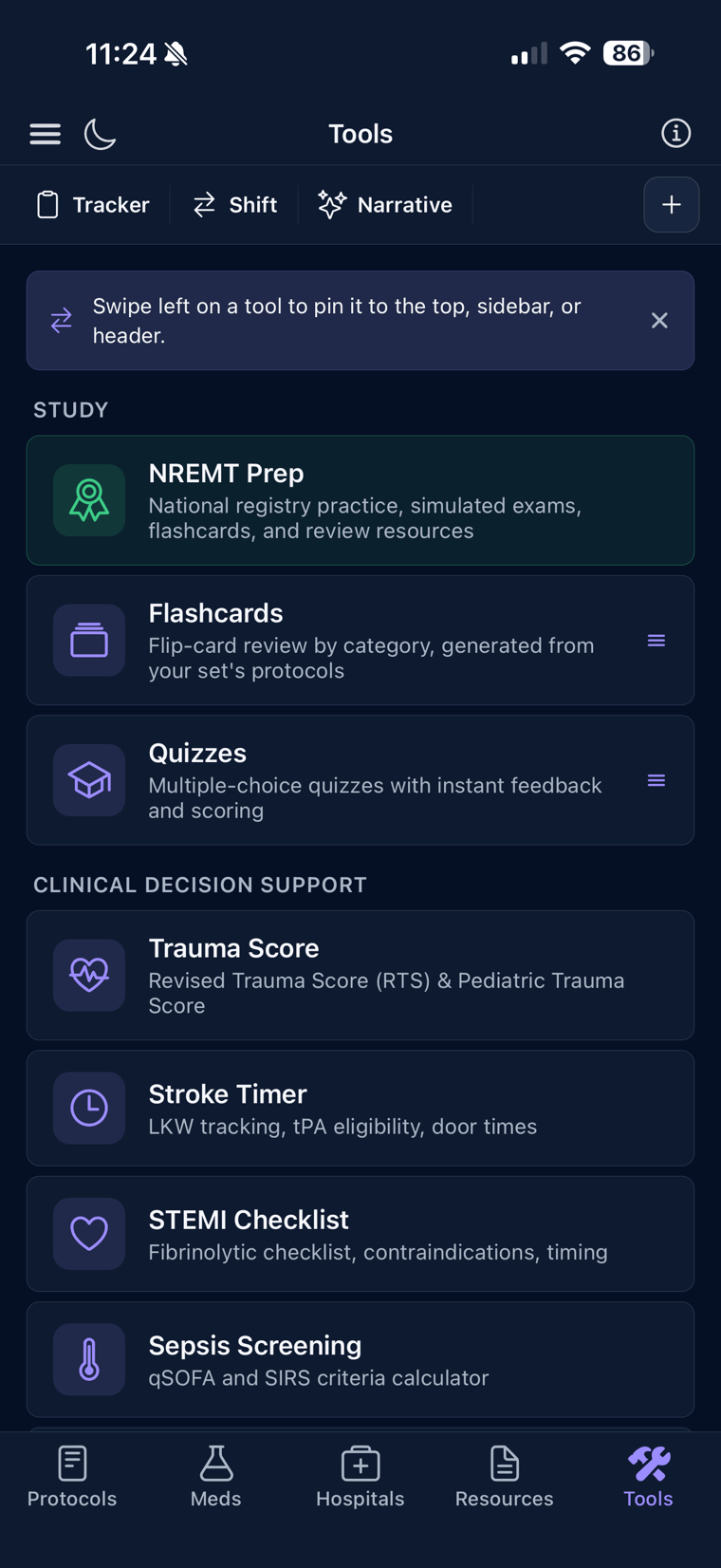
Pocket Protocols showing Rhode Island's protocols, medications, and hospitals — searchable and fully offline.
What's covered in Rhode Island
The protocol set serving Rhode Island right now.
Rhode Island Statewide Protocols
Study tools for Rhode Island Statewide Protocols
A few real flashcards and quiz questions from Rhode Island's own protocols — the full set, plus a spaced-review deck, is in the app.
Flashcards
3-3-2 rule (LEMON 'E') — what are the three measurements?
IM injection sites: landmark identification for the ventrogluteal site
Why is cardioversion synchronized with the cardiac cycle?
CO Exposure: When is cardiac monitoring and multi-lead ECG indicated?
12-Lead ECG Acquisition — Indications
What action is taken if the patient deteriorates into VF or pulseless VT during synchronized cardioversion attempts?
K9 Cardiac Arrest: CPR compression parameters and positioning
WPW/pre-excitation syndrome: calcium channel blocker contraindication and treatment
Quiz questions
You are managing an adult patient in cardiac arrest with a non-shockable rhythm. The patient has IV access established above the diaphragm. According to the protocol, what is the correct epinephrine dosing regimen?
- 1 mg IV/IO every 3 minutes to a maximum of 3 doses
- ✓ 1 mg IV/IO every 5 minutes to a maximum of 5 doses
- 0.5 mg IV/IO every 5 minutes to a maximum of 5 doses
- 1 mg IV/IO every 5 minutes with no maximum dose limit
A patient with a history of atrial fibrillation presents with a narrow complex tachycardia at 140 bpm. His SBP is 98 mmHg and you plan to administer diltiazem. According to the adult narrow complex tachycardia protocol, what should you consider administering first?
- Adenosine 12 mg rapid IV push
- Normal saline 500-1000 ml IV/IO bolus
- ✓ Calcium chloride 1 gm slow IV/IO
- Amiodarone 150 mg IV over 10 minutes
According to the ADHF/Pulmonary Edema protocol, CPAP (up to 10 cmH₂O) should be applied when a patient presents with respiratory distress, crackles on lung auscultation, or SpO₂ less than 92%. What is the minimum systolic blood pressure (SBP) required before initiating CPAP?
- SBP ≥ 80 mmHg
- ✓ SBP ≥ 90 mmHg
- SBP ≥ 100 mmHg
- SBP ≥ 110 mmHg
You are preparing to perform synchronized cardioversion on an unstable patient in rapid atrial fibrillation. After setting the defibrillator to synchronized mode, you observe that R wave markers do not appear on the screen. What is the most appropriate next action?
- Immediately proceed with shock delivery regardless of marker display
- Switch to unsynchronized (defibrillation) mode and deliver the shock
- ✓ Select another lead or reposition the ECG electrodes; increasing gain to increase QRS amplitude may also help
- Abort the procedure and transport the patient without cardioversion
According to the 12-lead ECG acquisition protocol, which of the following patients does NOT automatically meet criteria for a 12-lead ECG based solely on the listed indications?
- A 40-year-old male with a complaint of heartburn and a history of diabetes
- A 30-year-old female with weakness, dizziness, and nausea
- A 38-year-old male with non-traumatic chest pain
- ✓ A 25-year-old male with palpitations and no significant medical history
You are treating a K9 in cardiac arrest. Which of the following statements correctly describes the proper CPR technique according to the protocol?
- Place the K9 dorsally (back down), perform compressions at 60-80/min to a depth of 1/2-1/3 of chest width, with a 15:2 compression-to-ventilation ratio.
- ✓ Place the K9 laterally recumbent, perform compressions at 100-120/min to a depth of 1/2-1/3 of chest width, with a 30:2 compression-to-ventilation ratio.
- Place the K9 laterally recumbent, perform compressions at 100-120/min to a depth of 1/4-1/2 of chest width, with a 15:2 compression-to-ventilation ratio.
- Place all K9s dorsally (back down), perform compressions at 100-120/min to a depth of 1/2-1/3 of chest width, with a 30:2 compression-to-ventilation ratio.
Sourced from Rhode Island's EMS authority
Pocket Protocols brings Rhode Island's EMS protocols into a faster, fully offline app.
Rhode Island protocols — FAQ
Are Rhode Island's EMS protocols available offline?
Are the protocols specific to my county in Rhode Island?
Is Pocket Protocols official, or affiliated with Rhode Island?
How do Rhode Island protocol updates reach the app?
Carry Rhode Island's protocols on every call.
Download Pocket Protocols and keep your county's complete protocol set in your pocket — online or off.