South Carolina EMS protocols,
in your pocket.
Offline, county-specific protocols for South Carolina EMS providers — searchable, with a full medication reference, hospital finder, and study tools built in.
Covering 46 counties in South Carolina · Protocols current as of June 18, 2026
See it in the field
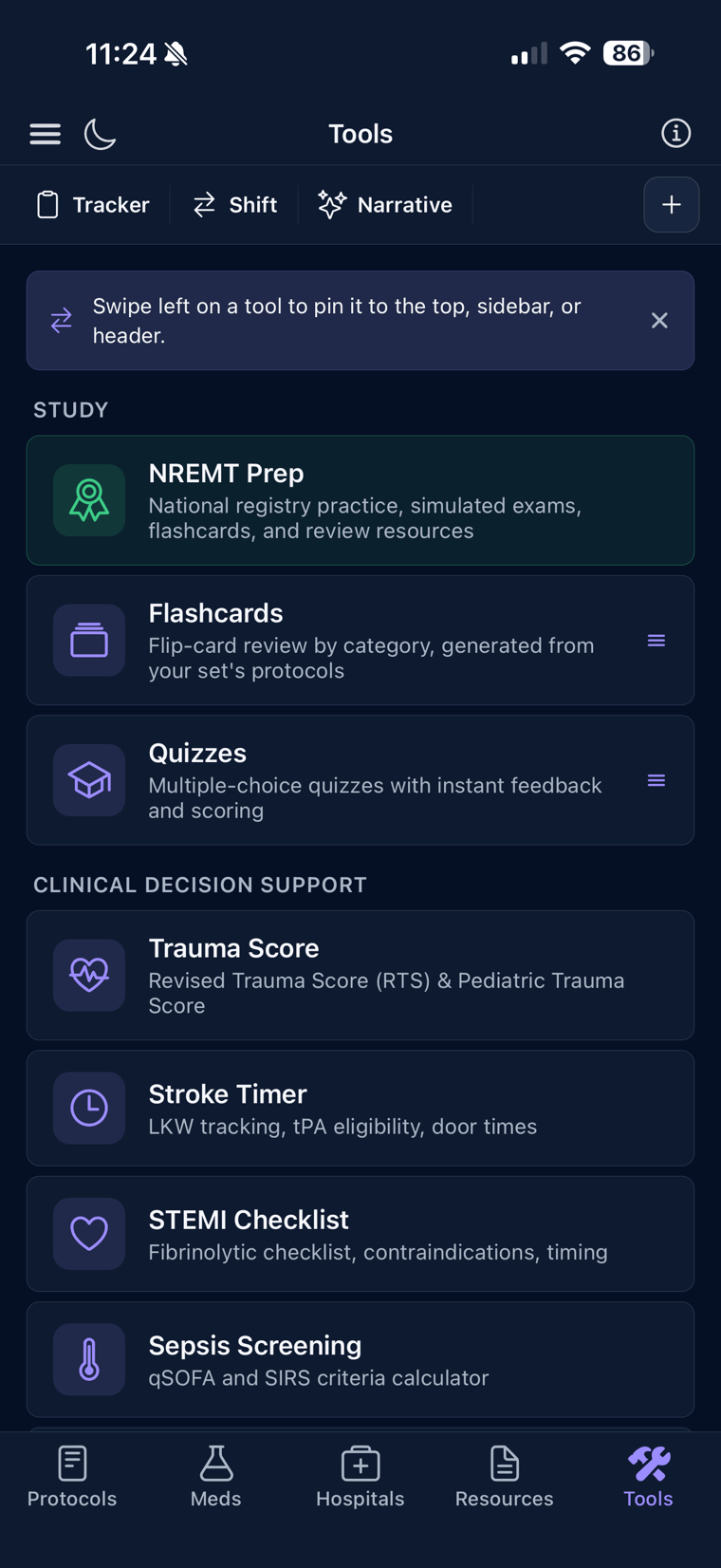
Pocket Protocols showing South Carolina's protocols, medications, and hospitals — searchable and fully offline.
What's covered in South Carolina
The protocol set serving South Carolina right now.
South Carolina EMS Clinical Operating Guidelines
Study tools for South Carolina EMS Clinical Operating Guidelines
A few real flashcards and quiz questions from South Carolina's own protocols — the full set, plus a spaced-review deck, is in the app.
Flashcards
STEMI Definition (EMS Criteria)
Criteria for Withholding CPR: Downtime >15 minutes
ECG criteria for V-Tach with a pulse
LVAD CPR Decision: When is CPR initiated?
Fibrinolysis Contraindications: Blood Pressure Thresholds
VF/Pulseless VTach: Treatment Priority Order
Symptomatic pediatric bradycardia: rate threshold and serious signs
STEMI ECG definition
Quiz questions
You arrive on scene to find a 45-year-old male patient who is apneic, pulseless, and in ventricular fibrillation. The arrest was NOT witnessed by EMS. According to the VF/Pulseless VTach protocol, what is the correct FIRST action?
- Immediately defibrillate x1, then begin CPR
- ✓ Perform 2 full minutes of high-quality CPR, then defibrillate
- Establish vascular access, administer epinephrine, then defibrillate
- Apply the cardiac monitor, obtain a 12-lead ECG, then defibrillate
According to the Reperfusion Checklist, which of the following blood pressure findings would indicate that fibrinolysis MAY be contraindicated?
- Systolic Blood Pressure of 170 mm Hg
- Diastolic Blood Pressure of 100 mm Hg
- ✓ Right vs. Left Arm Systolic Blood Pressure difference of 20 mm Hg
- Systolic Blood Pressure of 160 mm Hg with a Diastolic of 90 mm Hg
You arrive on scene to find an LVAD patient who is unresponsive and not breathing normally. There is no loud alarm from the external controller. You auscultate the chest and hear NO humming sound. According to Algorithm 1, what is your next action?
- Immediately begin chest compressions at standard CPR rate
- ✓ Assume LVAD failure, prioritize moving to Algorithm 2, and start ventilations at 10-12 per minute without starting chest compressions
- Contact the VAD coordinator and await further instructions before intervening
- Defibrillate immediately, as VF is the assumed rhythm
According to SC C.O.G. 200-317, under which TWO conditions must BOTH be met before initiating CPR on an LVAD patient in cardiac arrest?
- The patient has no palpable pulse AND the device alarm is sounding
- ✓ The confirmed pump has stopped and troubleshooting has failed, AND the patient is unresponsive without detectable signs of life
- The VAD coordinator has been contacted AND medical control has given authorization
- The patient has no audible hum AND the battery is confirmed dead
You respond to a patient with severe hypothermia (core temperature < 82°F / 28°C) who is in ventricular fibrillation. Which of the following actions is MOST consistent with the Hypothermia protocol?
- Defibrillate repeatedly until ROSC is achieved, then transport.
- Defibrillate once, then contact Medical Control for direction regarding further attempts, and continue antiarrhythmics at standard intervals.
- ✓ Defibrillate once if indicated, contact Medical Control regarding deferring further attempts, and note that antiarrhythmics may not work below 86°F and pacing should not be done.
- Withhold defibrillation entirely and focus only on aggressive active rewarming.
A paramedic is managing a patient in asystole. Which EtCO2 finding and corresponding time threshold should prompt consideration of termination of resuscitation, per SC C.O.G. 200-311?
- EtCO2 < 10 mmHg after 30 minutes; EtCO2 ≥ 10 mmHg after 20 minutes
- ✓ EtCO2 < 10 mmHg after 20 minutes; EtCO2 ≥ 10 mmHg after 30 minutes
- EtCO2 < 20 mmHg after 15 minutes; EtCO2 ≥ 20 mmHg after 25 minutes
- EtCO2 < 10 mmHg after 15 minutes; EtCO2 ≥ 10 mmHg after 25 minutes
Sourced from South Carolina's EMS authority
Pocket Protocols brings South Carolina's EMS protocols into a faster, fully offline app.
South Carolina protocols — FAQ
Are South Carolina's EMS protocols available offline?
Are the protocols specific to my county in South Carolina?
Is Pocket Protocols official, or affiliated with South Carolina?
How do South Carolina protocol updates reach the app?
Carry South Carolina's protocols on every call.
Download Pocket Protocols and keep your county's complete protocol set in your pocket — online or off.